
Packaging is no longer limited to protecting a product. Today, it is an important part of branding, product identification, and customer experience. As competition increases across FMCG, food, cosmetics, household products, and consumer goods, manufacturers are looking for better ways to make plastic packaging attractive while maintaining durability and production efficiency.
This is where In-Mould Labelling (IML) has become an important packaging and decoration technology.
Businesses searching for the Best In-Mould Label Manufacturers in India IML are generally looking for reliable solutions that can deliver consistent decoration, high-quality graphics, excellent appearance, and compatibility with modern manufacturing processes. Choosing the right supplier is important because the final quality of an IML product depends on several factors, including label material, printing quality, moulding process, surface characteristics, and production conditions.
Prizeman Foils is a manufacturer of decorative foils, hot stamping solutions, heat transfer systems, and related product-decoration technologies. With more than four decades of experience in the decorative solutions industry, the company focuses on combining manufacturing expertise, innovation, and application-specific solutions.
What Is In Mould Labelling (IML)?
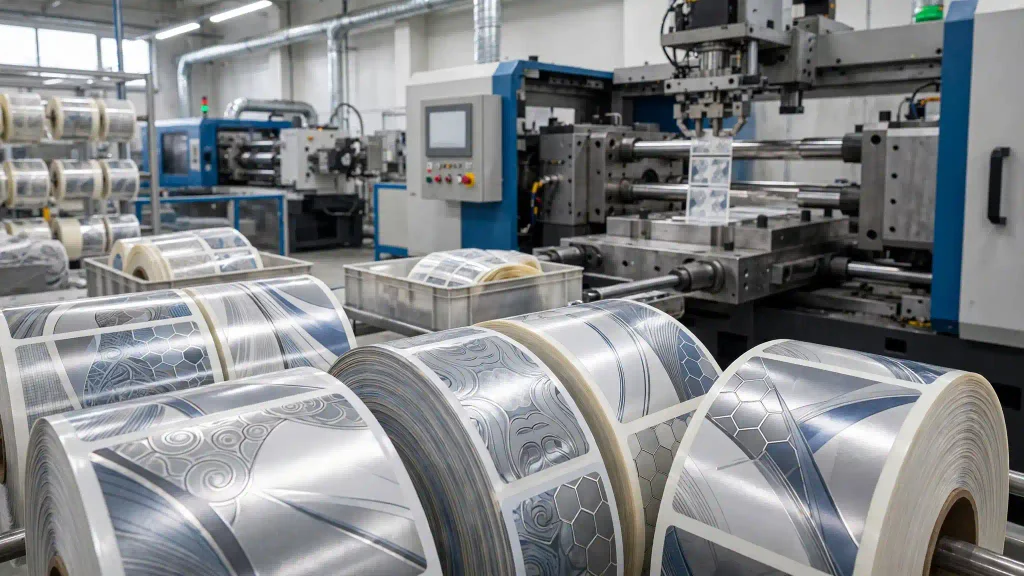
In-Mould Labelling, commonly abbreviated as IML, is a labeling method in which a printed label is incorporated into a plastic product during the moulding process.
Instead of manufacturing a container or plastic component first and applying a label afterward, the label is positioned in the mould as part of the production process. When the plastic material is moulded, the label becomes integrated with the finished product.
This creates a clean and professionally finished appearance while allowing manufacturers to combine product decoration with their existing moulding process.
IML is particularly useful where manufacturers need:
- High-quality product graphics
- Consistent label positioning
- Attractive branding
- Durable decoration
- Efficient production
- Premium product presentation
- Detailed designs and visual effects
The exact performance of an IML solution depends on the label construction, plastic substrate, moulding technology, equipment, and production parameters.
Why Are More Manufacturers & Suppliers Choosing IML?
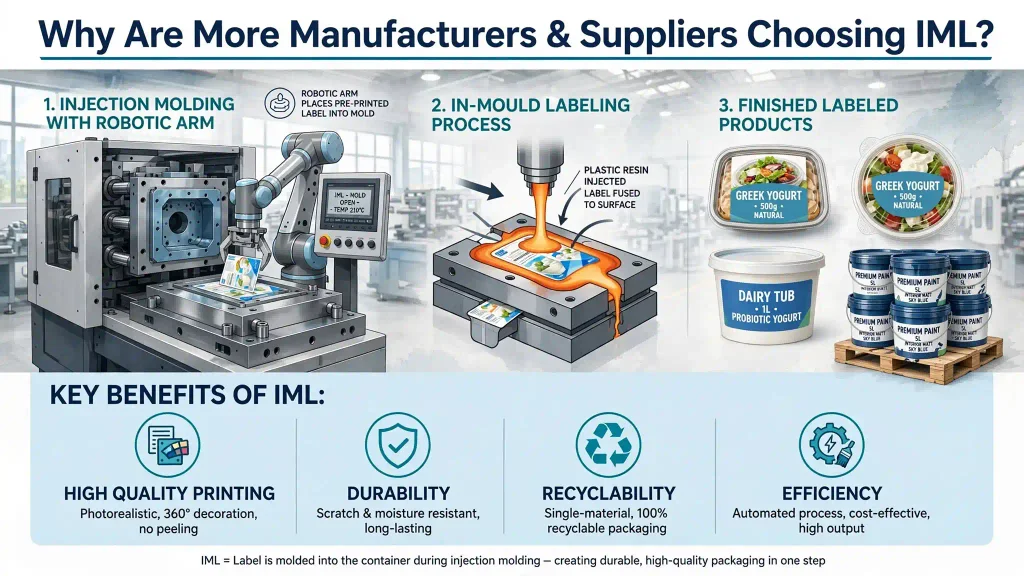
The packaging industry is changing rapidly. Consumers expect products to look attractive, modern, Stylish and professionally packaged. At the same time, manufacturers & Suppliers want production processes that are efficient and repeatable.
Traditional labeling methods can involve separate labeling operations after the product has been moulded. IML brings labeling into the moulding workflow, making it an modern option for manufacturers seeking greater process integration.
Improved Product Appearance
A well-designed IML label can give sharp graphics, powerful branding, and a clean finish. This can help products stand out on retail shelves.
Integrated Decoration
Because the label is incorporated during moulding, the decoration becomes an integral part of the finished plastic product rather than appearing as a separately applied sticker.
Consistent Branding
For products manufactured in Huge quantities, maintaining consistent branding is essential. Automated IML processes can support repeatable label placement and product appearance.
Suitable for High-Volume Manufacturing
IML is particularly relevant to industries where large quantities of identical plastic products are manufactured and consistent decoration is required.
Greater Design Flexibility
Modern decorative technologies allow manufacturers to explore different colors, patterns, metallic effects, and branding elements depending on the product and application.
Why Choosing the Right IML Supplier Matters
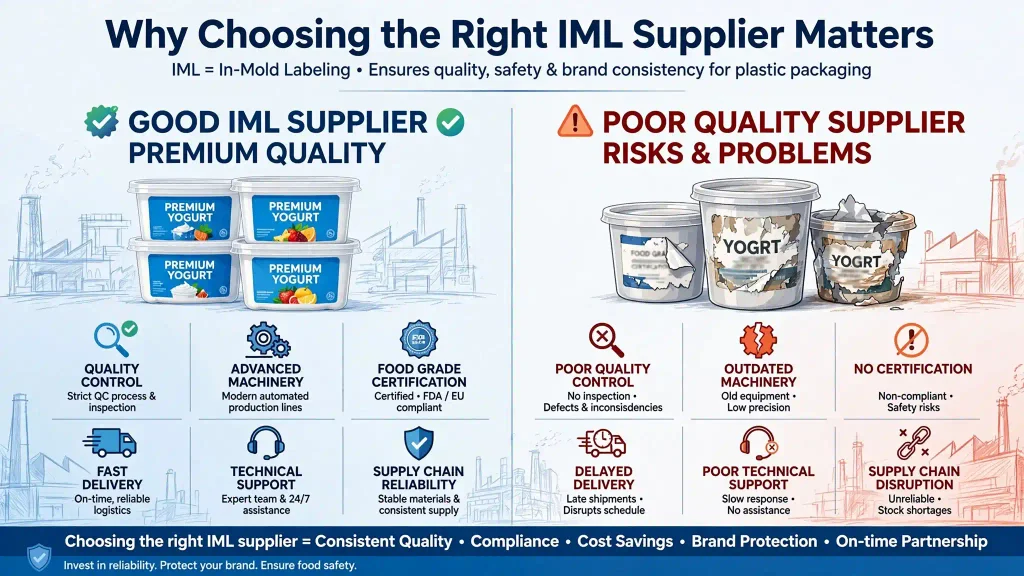
Searching for the Best In-Mould Label Manufacturers in India IML should not be based only on product price.
A manufacturing partner should understand the relationship between the decorative material, substrate, machinery, mould design, and production process.
Important factors to evaluate include:
Material Compatibility
Different plastic materials have different surface characteristics. The chosen labeling or decorative solution needs to be compatible with the substrate and production process.
Plastic applications can involve materials such as PP, HDPE, PET, ABS, SAN, and other polymers. Prizeman’s plastic-decoration applications cover several major plastic materials, including ABS, PP, HDPE, SAN, and PET.
Transfer and Application Performance
Consistent transfer is essential in industrial decoration. Poor release, uneven transfer, or inconsistent adhesion can affect product appearance and increase production waste.
Visual Quality
Packaging is often the first interaction a customer has with a product. Sharp text, clean logos, attractive colors, and consistent finishes therefore play an important role.
Production Requirements
A suitable solution should be considered according to production speed, equipment, product geometry, mould design, and other manufacturing parameters.
Technical Support
Industrial decoration is not a one-size-fits-all process. Technical guidance can help manufacturers & suppliers identify suitable materials and application methods for specific products.
Prizeman Foils for Modern Product Decoration
Prizeman Foils operates in the field of decorative foils, hot stamping, heat transfer systems, Textile Gold Foil, Hot Stamping Foils and product-decoration consumables. The company describes itself as a complete hot stamping and heat transfer product-decoration solutions provider.
Its approach combines product development, manufacturing expertise, application knowledge, and customer-focused support.
Prizeman’s wider product portfolio includes decorative solutions designed to create different visual effects and finishes. These include metallic, pigment, matte, pearl, and holographic effects for relevant applications.
This broader experience in product decoration can be valuable for manufacturers & suppliers looking beyond basic labeling and exploring premium modern decorative finishes.
IML and Decorative Finishes
In-mould labeling is primarily associated with integrated product labeling, but premium packaging requirements often go beyond basic product information.
Brands may want their packaging to include:
- Metallic branding
- Premium logos
- Decorative patterns
- High-contrast graphics
- Special color effects
- Gloss and matte finishes
- Promotional elements
- Distinctive visual identities
Decorative foil technologies can complement these requirements in suitable applications.
Metallic Finishes
Metallic effects can give packaging a premium appearance. Gold, silver, and chrome are commonly associated with premium, luxury, modern and high-value product presentation.
Pigment Finishes
Pigment foils can be used when a strong, opaque color effect is required. Prizeman’s pigment foil range includes solutions designed for detail stamping and applications requiring color depth and definition.
Holographic Effects
Holographic finishes can provide changing visual patterns and reflective effects. They can be useful when a brand wants its packaging to have a distinctive appearance.
Matte and Pearl Effects
Subtle finishes can also be used where brands want a sophisticated rather than highly reflective appearance.
The appropriate finish depends on the product, substrate, design, production equipment, and desired result.
Applications of IML and Plastic Product Decoration
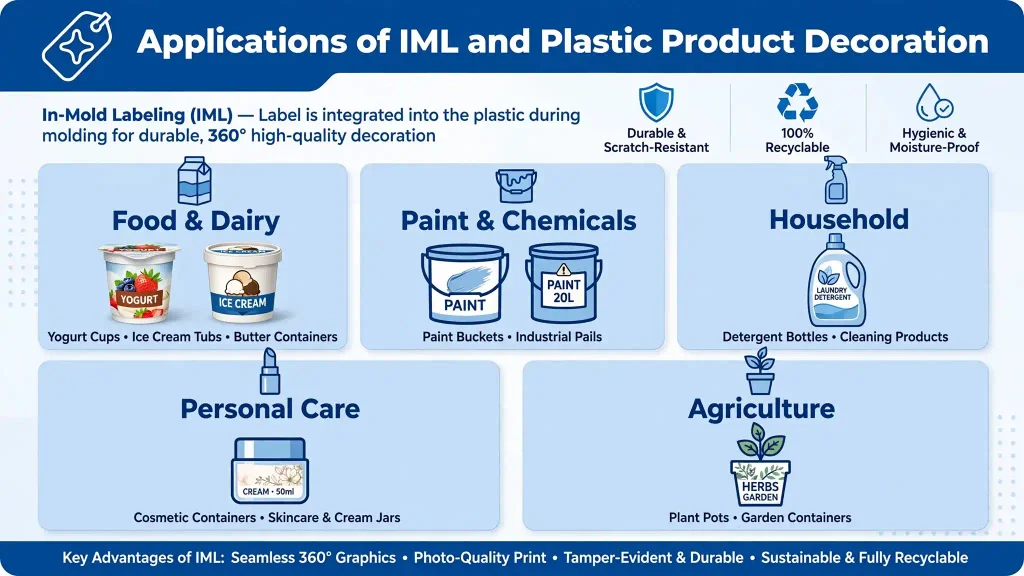
The use of modern labeling and decoration technologies extends across several industries.
Food Packaging
Plastic containers used for food products can benefit from attractive, clearly printed labels and integrated decoration.
Applications may include:
- Food containers
- Dairy packaging
- Storage tubs
- Snack containers
- Frozen-food packaging
conclusion should always be selected according to the specific packaging material and regulatory requirements of the application.
Household Products
Household plastic products are another important area for product decoration.
Applications can include:
- Buckets
- Lunch boxes
- Storage containers
- Household accessories
- Decorative panels
- Plastic utility products
Prizeman specifically highlights applications across houseware and home appliances and lists products such as household buckets, modular switch plates, lunch boxes, and decorative wall panels.
Cosmetic Packaging
Cosmetic packaging depends heavily on visual presentation. Premium decoration can help communicate a product’s positioning and create stronger shelf appeal.
Applications can include:
- Cosmetic containers
- Cream jars
- Lotion bottles
- Tubes
- Caps and closures
- Makeup packaging
Prizeman provides decorative solutions for cosmetic and personal-care packaging, including bottles, tubes, jars, caps, closures, mascara containers, lip-gloss containers, and other packaging formats.
Personal Care Products
Personal-care brands can use high-quality decoration to strengthen packaging identity across products such as shampoo, conditioner, lotion, shower gel, and skincare packaging.
Industrial Plastic Products
Plastic components used in industrial environments may require branding, identification, or decorative elements. Depending on the application, suitable foil and transfer technologies can provide functional or aesthetic decoration.
Automotive Components
Automotive products often require consistent decoration on components with complex geometries.
Prizeman provides automotive decoration solutions for interior, exterior, and under-hood applications, including air vents, door handles, dashboards, grills, license plates, engine covers, and battery housings.
IML vs Traditional Labeling
One of the main differences between IML and conventional labeling is when the label is applied.
In traditional labeling, the plastic product is generally manufactured first and then decorated or labeled in a separate operation.
With IML, the label is introduced into the moulding process.
| Feature | In Mould Labelling | Traditional Labeling |
|---|---|---|
| Label application | During moulding | Usually after production |
| Process integration | High | Separate operation may be required |
| Appearance | Integrated finish | Applied label appearance |
| Automation | Suitable for automated production | Depends on equipment |
| Design possibilities | High | High |
| Durability | Depends on construction and process | Depends on label and adhesive |
The actual advantages vary according to the product design, label material, equipment, and production conditions.
Benefits of In Mould Labelling for Manufacturers
Attractive Branding
IML provides manufacturers with an effective way to incorporate branding directly into plastic products.
Professional Appearance
Integrated decoration can create a clean and finished look that supports premium product presentation.
Production Integration
Combining labeling and moulding can help reduce the need for a separate post-production labeling stage in suitable manufacturing setups.
Consistent Results
Automated systems can help maintain consistent positioning and repeatability across large production runs.
Multiple Design Possibilities
Manufacturers can use detailed graphics, logos, product information, colors, and decorative elements to create differentiated packaging.
Reduced Handling
When labeling is incorporated into the moulding process, additional product handling associated with a separate labeling operation may be reduced.
FAQs – In-Mould Labels (IML)
1. What are In-Mould Labels?
In-Mould Labels are integrated into plastic packaging during the moulding process.
2. What are the benefits of IML?
IML provides durable, attractive, and high-quality packaging.
3. Where are IML labels used?
They are commonly used for food, cosmetic, household, and industrial packaging.
4. Are IML labels moisture-resistant?
Yes, IML labels offer excellent resistance to moisture and wear.
5. Do IML labels provide high-quality printing?
Yes, they support sharp graphics and high-quality printing.
6. Why choose Prizeman for IML?
Prizeman offers reliable and high-quality In-Mould Label solutions.
7. Are IML labels durable?
Yes, they are designed for long-lasting packaging applications.
8. Can IML labels improve packaging appearance?
Yes, IML creates a seamless and premium packaging finish.